
Vox HDC-99 Guitar: 2011-2013
In 2008 Vox was poised to release their most advanced and expensive guitar to date, the Virage, little knowing the economic storms that lay just around the corner. Despite reaching unprecedented levels in early 2007, the global economy was on an unsustainable path, leading to the Great Recession-the worst economic downturn since the Great Depression-from December 2007 to June 2009. The market for expensive, discretionary items such as top end guitars had all but evaporated just as the Virage came to market.
Korg, the parent company of Vox, had a considerable upfront investment in the Virage guitar program. They hired three of the best minds in guitar business, Rich Lasner, Erik Kirkland and Bob McDonald in 2007 to head R&D for the project. A facility named G-ROK (Korg spelled backwards) was established in Novato CA for developmental work. Untold man hours would be spent drafting and testing 3D CAD designs to facilitate carving the semi-hollow Virage bodies on a CNC router. Not content to incorporate conventional, "off the shelf" parts, the team at G-ROK designed the "MaxContact" bridge, "Super Smooth Custom Tuners," the "Three-90" pickup (2008) and the "Coaxe" pickup (2010) specifically for Virage production.
A decision was made in 2009 to expand the Virage line from just two premium priced models to a full range of guitars at popular price points. Included were the SDC-22 (street price $499), the SSC-33 and SDC-33 (street price $699), SSC-55 and SDC-55 (street price $1299), SDC-77 (street price $1399) and the HDC-99 (street price $1799). Each of these instruments would in some way benefit from G-ROK's original Virage construction techniques, pickups, and hardware.
|
The Vox HDC-99 Guitar
With a US street price of $1799.99 including hard shell case, the Vox HDC-99 was the top of the range of the 22-99 Series guitars. It appeared in the 2012 full line Vox catalog.
Three Piece Semi-Hollow Construction
The Vox HDC-99 combined the 3D contoured body designed for the Vox Virage with traditional laminated semi-hollow guitar construction techniques. Its arched top and back were made from three layer maple plywood, overlaid with a quilted maple veneer and press formed into shape. The rim and central core structure of the HDC-99 were machined out of a solid block of mahogany. The central core structure incorporated two prong-shaped "tone bars" that reinforced the guitar from the neck joint to the bridge. These tone bars improved string balance, minimized feedback and provided the ideal structure to mount the bridge and pickups. The arched top and back were then glued to the mahogany rim to create the body shell.
Three colors were offered, the HDC-99-UB-QM Sunburst, HDC-99-WB-QM Wineburst and the HDC-99-CB-QM Cherryburst. The Cherryburst model was a limited edition sold primarily in Japan and some EU countries. |
|
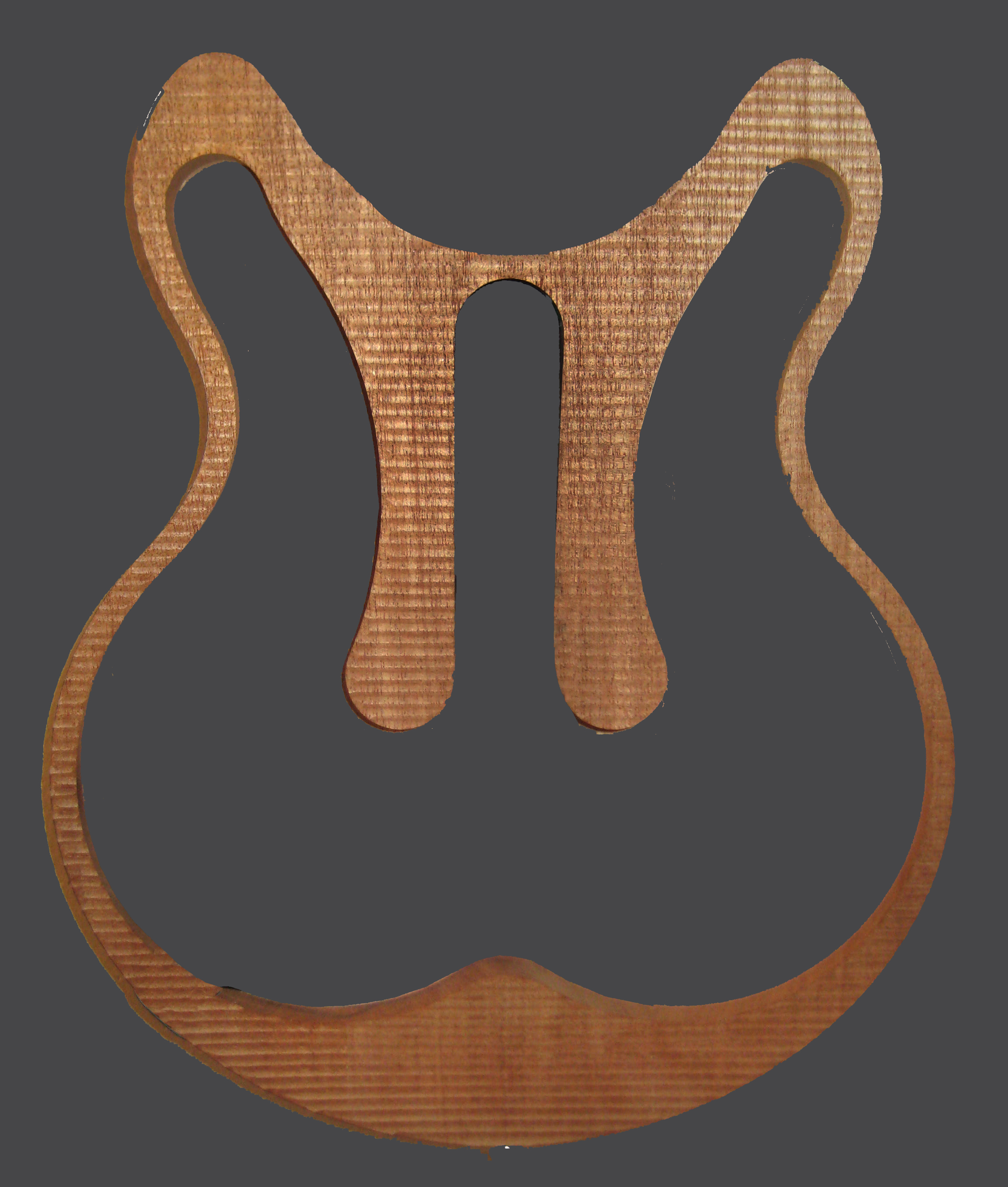
HDC-99 Rim and Central Core Sttructure |
|
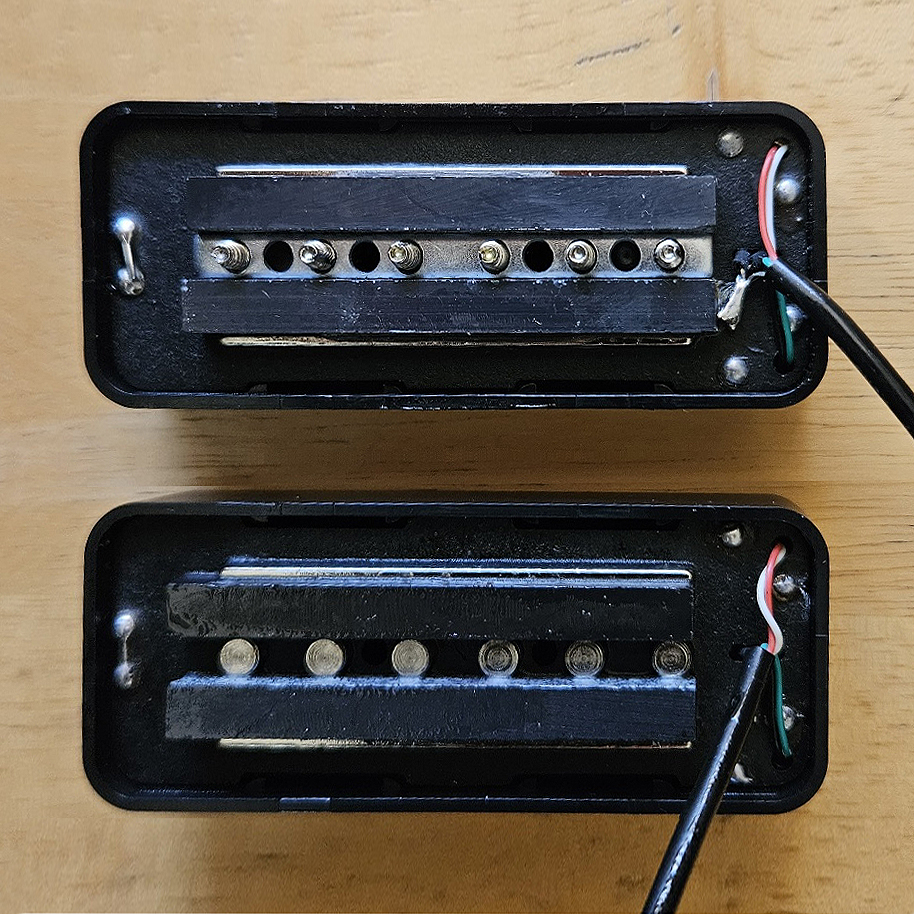
Rear View of the "Vintage" Vox CoAxe Pickup
Rear View of the "Modern" Vox CoAxe Pickup |
|
3D Contoured Body
Like the Virage, the HDC-99 employed what Vox called a "3D contoured body" (see side profile photo above). Not only are the front and rear of the guitar arched, the body as a whole drops away from the plane of the neck and in effect curves around your body as you play it. This allowed the HDC-99 to better conform to a player's body whether seated or standing.
Vox CoAxe Pickups
Vox developed two versions of the CoAxe pickup, the "Modern" and the "Vintage." The "Modern" CoAxe was included in the Virage II, the 33, 55, and the 77 Series plus the bridge position of the HDC-99. The "Vintage" CoAxe was installed in the neck position of the HDC-99.
The CoAxe pickup featured a unique design with two concentric coils: a central sensing coil and a coaxial hum-cancelling coil. The "Modern" CoAxe's central sensing coil had six fixed "slug" pole pieces that were fastened directly to the magnet, boosting string attack and output. The "Vintage" CoAxe's central coil had six adjustable pole pieces mounted to a steel plate fastened to the magnet. This modification softened the string attack while emphasizing mid response and adding warmth to the tone.1 The coaxial hum-canceling coil surrounded the central coil, eliminating electrical interference while preserving the pickup's treble response. |
Controls
The HDC-99 not only shared the CoAxe pickups with the Virage, it also shared its controls, switches and wiring harness. A pair of three position Mode Switches facilitated the selection between single-coil, soapbar or humbucker tones for each pickup. A master volume control, master tone control and a conventional three-way pickup selector (bridge-both-neck) were also included.
MaxConnect™ Aluminum Bridge
The MaxConnect™ bridge was originally designed by G-ROK for the Vox Virage guitar. The bridge was a precision cast, satin finish aluminum assembly weighing a scant two ounces. Vox claimed it had the longest range of saddle adjustment of any bridge on the market, allowing correct intonation from the lightest to the heaviest of string sets. It also offered easy, "straight-in" access for restringing the guitar. Two brass studs, anchored to the guitar's internal bracing, secured the bridge to the body and allowed precise string height adjustments.
Vox Super Smooth Custom Tuners
The tuning stability of the HDC-99 was enhanced by the Vox "Super Smooth Custom Tuners," originally designed by G-ROK for the Vox Virage guitar. Each tuner set was composed of six individual, sealed units with chrome-plated cases. Their satin finished, wave motif pegs matched the satin finish of the MaxConnect™ bridge (see photo at right). |
|
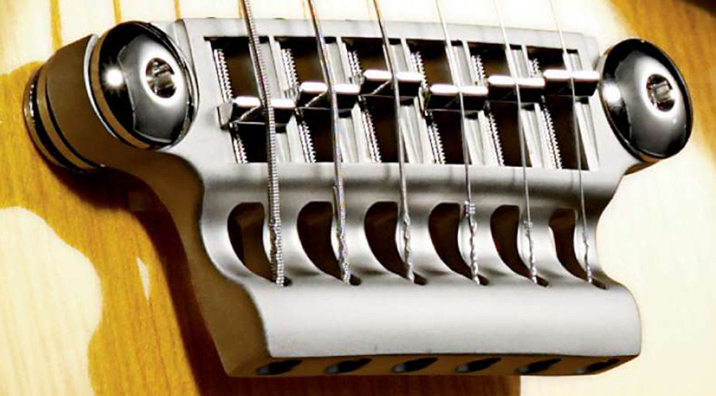
MaxConnect™ Cast Aluminum Bridge

Vox Super Smooth Custom Tuners - Wave Motif Tuning Peg
Photo Courtesy Parts is Parts (partsisparts.net)
|
 |
|
Neck
The Vox HDC-99 was equipped with a mahogany set neck with a bound ebony fretboard and rectangular acrylic inlays. It had a 25⅛" (638mm) scale length making it ⅜" longer than a typical Gibson and ⅜" shorter than most Fenders. The neck had 22 medium jumbo frets, a synthetic, self lubricating nut and an 11.8" (300mm) fretboard radius. The neck was ~1.69" (43mm) wide and ~0.83" (21mm) deep at the first fret and ~2" wide and .90 (23mm) deep at the twelfth. The neck met the body at the 17th fret.
A hand carved, custom set-in neck joint with an inverse heel allowed greater access to the upper frets (see photo at left).
|
Country of Origin
The Vox HDC-99 was designed in America by G-ROK of Novato CA and was built for Vox by SPG Musical Instruments of Incheon Korea.
Footnote
1) Even though Vox catalogs from 2011-2013 indicated that both HDC-99 pickups were the "vintage" CoAxe style, Vox has since confirmed to the Vox Showroom that in final production, only the neck pickup was the vintage type. The bridge pickup retained the original CoAxe design, allowing a blend of contemporary and vintage tones. Aside from their pole pieces, the "original" and "vintage" CoAxe pickups were identical. |
3_Footer

Photos and editorial content courtesy Gary Hahlbeck
Any and all material presented herein is protected by Copyright.
© 1998 - 2026 The Vox Showroom, all rights reserved
The images and editorial content in this web site may not be copied or reproduced
in online auction sites such as eBay, Reverb and Craig's List. Sellers may provide a link
to the Vox Showroom web site if they wish to refer to this copyrighted material.
|
URL: https://www.voxshowroom.com/us/guitar/99.html
|
