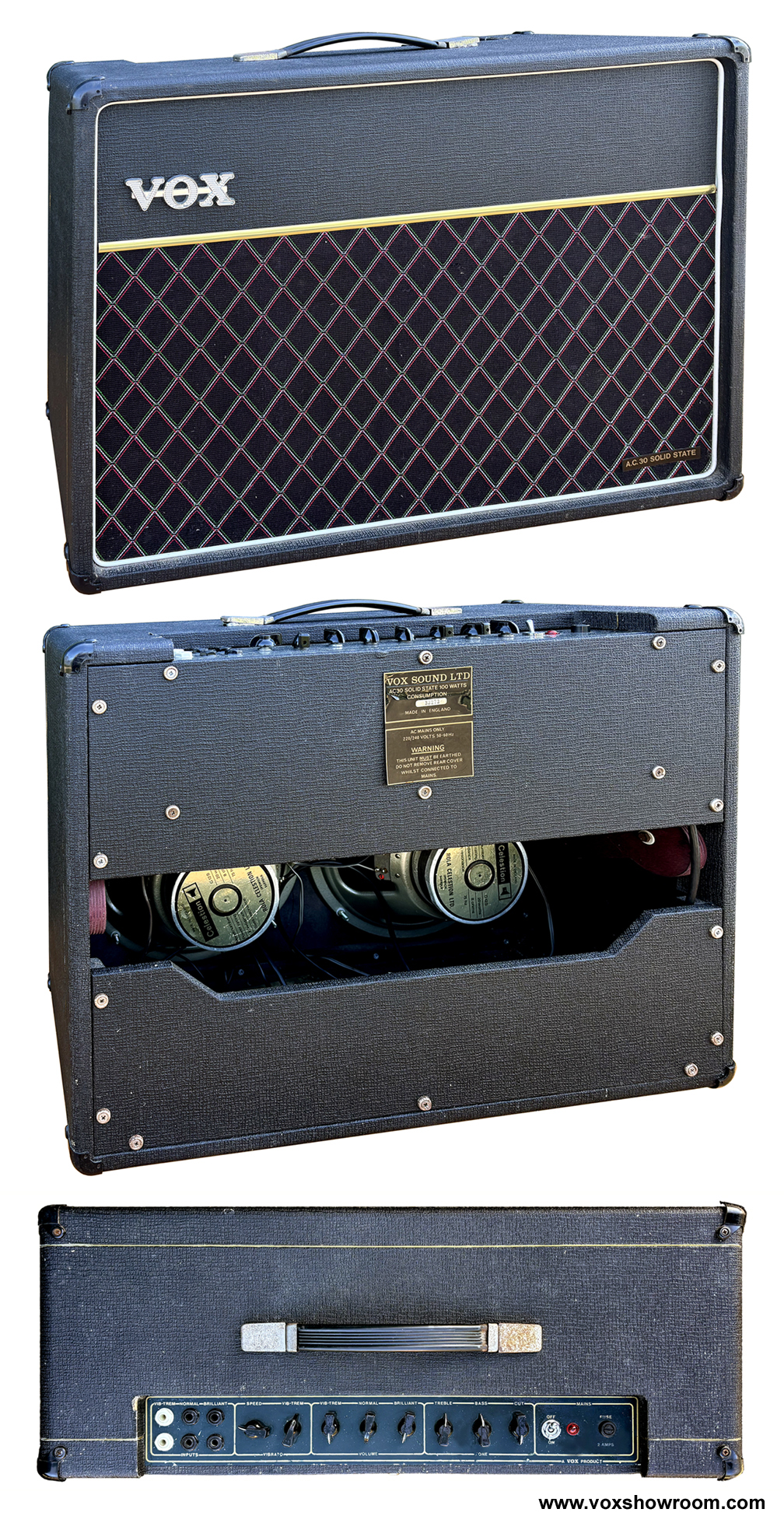
Vox AC30SS Solid State Amp, Early Production with Celestion G12S Speakers

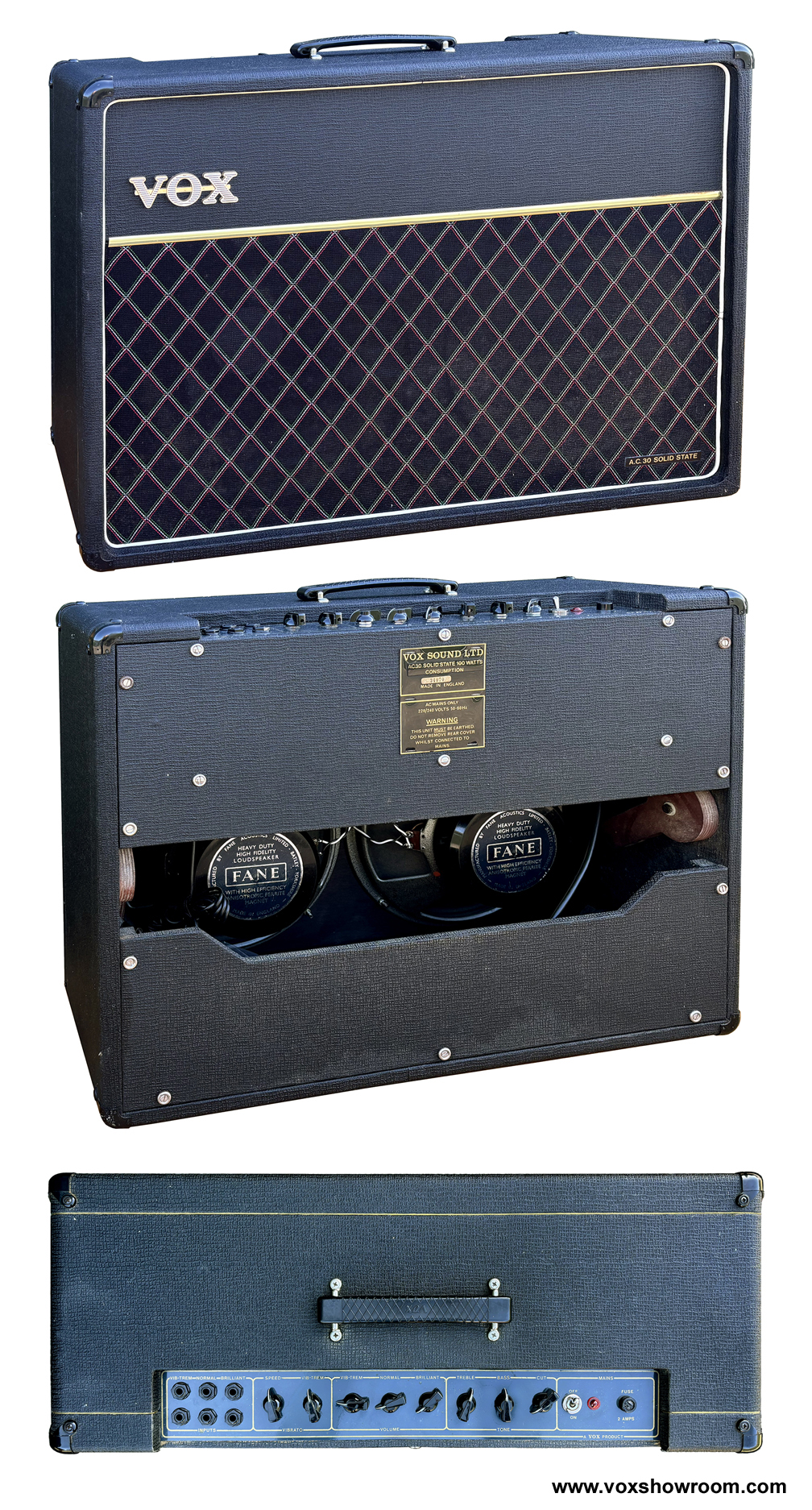
Vox AC30SS Solid State Amp, Later Production with Fane Speakers
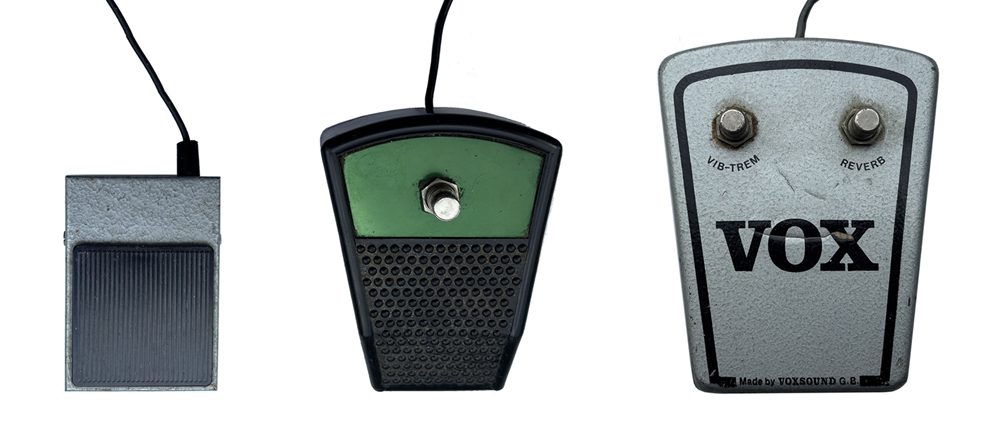
Early AC30SS Footswitch, Later AC30SS & AC30SSR Footswitches

Vox "Solid State 30" Amp from the 1977 Vox (Dallas) Catalog

Vox AC30SS and AC30SSR Amps from the 1979 Vox (Rose Morris) Catalog
|
|
During the 1960s and 1970s, many guitar amp manufacturers transitioned from tube to solid-state circuitry to take advantage of several key benefits. Well-engineered solid-state designs offered greater durability, lower maintenance, a significant reduction in weight and were generally cheaper to manufacture.
The T.60 - The First Solid-State Vox Amp
Between 1959 and 1964, Jennings Musical Industries established its entire legendary Vox "AC" series hand-wired tube amplifier lineup, but their 1962 foray into solid-state circuitry with the T.60 bass amp was problematic. Since modern silicon transistors weren't yet commonly available, the T.60 used germanium transistors, notoriously prone to instability, overheating and service issues. These technical malfunctions frustrated customers and forced Vox to pause further transistor-based development for a time.
Thomas Organ
Fueled by the 1964 "British Invasion," spearheaded by the Beatles, the Dave Clark Five and the Rolling Stones, American youth were introduced to Vox amplifiers, organs, and guitars. Consequently, Jennings appointed the Thomas Organ Company of Sepulveda, CA to be the exclusive North American importer and distributor of Vox gear in late 1964. Within a year, Thomas Organ offered JMI $1,000,000 for the rights to manufacture their own Vox designs in the U.S. JMI accepted the offer, effectively ending the importation of Vox gear from the UK to the US.
Believing that modular solid-state design and printed circuit board construction represented the industry's future, Thomas Organ moved away from Jennings traditional hand wired tube amp designs. With the North American manufacturing rights secured, Thomas Organ prepared to launch a completely new Vox amplifier line in 1966, built in California for the U.S. market.
Dick Denney Visits Thomas Organ - October 1965
In October 1965, Stan Cutler, the lead engineer at Thomas Organ, invited his UK counterpart at Vox, Dick Denney, to the Thomas labs in Sepulveda California. The purpose for the visit was to showcase the progress Thomas Organ was making in developing a new modular solid-state Vox amplifier line.
Denney was shown a modular design system consisting of fully featured, solid-state preamps—one for guitar and another for bass—that could be interchangably paired with 30, 60, or 120-watt power sections. This modular design strategy allowed Thomas Organ to efficiently build a diverse Vox amplifier line across various power levels while keeping manufacturing costs low.
Denney was also impressed to find that these Thomas engineered Vox amps were highly dependable, a stark contrast to the problematic T.60. His 1965 visit to California proved to be a turning point, set to have a profound impact on future UK Vox product development.
Jennings Vox UL Series Hybrid Amps - 1966
Launched in 1966, the Vox UL Series featured four guitar models (715, 730, 760, and 7120) and three bass models (430, 460, and 4120).
Reflecting the modular efficiency Dick Denney observed at Thomas Organ, all four guitar amplifiers used an identical solid-state preamp and control circuit while the three bass models shared a separate, dedicated solid-state preamp design. Additionally, the 30, 60, and 120 watt tube power sections were standardized across both the guitar and bass lineups.
Jennings Goes Solid State - 1967
The full impact of Dick Denney’s 1965 visit to Thomas Organ was clear by September 1967. Vox replaced the short-lived UL Series with a brand-new modular solid-state amplifier line at the UK music trade fair at the Russell Hotel. Their features and control panel layout were unabashedly copied from Thomas Vox. To support the launch, Vox released a promotional flyer highlighting the many advantages of their new modular solid-state construction.
Vox Announces a Solid State AC-30
Perhaps most intriguing was a brief announcement in the "Vox Parade - Autumn 1967" hand-out distributed at the trade fair. In addition to debuting the new solid-state guitar and bass amplifiers, the flyer officially introduced solid-state replacements for the legendary AC-15 and AC-30. From the Vox Parade flyer:
"The AC-15 and AC-30 are back! Both Dealer and User alike have demanded it! Now renamed, Classic and Reliant, these fine amps, that have played a major part in establishing the Vox image throughout the world have been redesigned with ALL SOLID STATE circuitry. They look the same as before - style and shape remain unchanged - but the added advantages and features that SOLID STATE gives, means that even the Best has been bettered!"
Royston Bankruptcy
However, due to circumstances beyond their control, production at Vox would soon grind to a halt. As a subsidiary of Royston Industries, Vox suffered when the UK conglomerate’s poor business choices led to receivership in late 1967. This forced a production shutdown at Vox until mid-1968 while the bankruptcy case unfolded, ultimately killing off plans for the solid-state AC-15 and AC-30.
The 1970s proved to be a volatile decade for Vox as the company passed through a series of owners. Following Royston's bankruptcy, ownership transferred to the investment firm Corinthian Securities in late 1969, which then sold the brand in 1971 to Birch-Stolec, a key transformer supplier. Vox was then acquired by Dallas Musical Industries (DMI) in 1973 before finally being sold to Rose-Morris (R-M) in 1978.
The Vox AC30SS & AC30SSR Solid-State AC-30
A decade after JMI Vox’s 1967 solid state AC-30 version dubbed the "Reliant" failed to reach production, Vox launched the solid-state AC30SS in 1977 under the ownership of Dallas Musical Industries (DMI). The AC30SSR followed shortly after, adding a Hammond Accutronics reverb circuit to the AC30SS. Both amplifiers were manufactured in England from 1977 to 1980 at a DMI facility in Shoeburyness, Southend-on-Sea. Even after Dallas sold Vox to the UK musical product distributor Rose-Morris in 1978, production of the AC30SS and AC30SSR continued at the Shoeburyness plant under a contract agreement.
The serial plates of solid-state AC-30 amps sold by Dallas (1977- early 1978} list "Vox Sound Limited" as the manufacturer. This evolved to simply "Vox Limited" in the Rose-Morris ownership era (later 1978 and onward).
Both the AC30SS and AC30SSR preserved the signature features of the traditional tube driven AC-30, featuring six inputs across three channels (Normal, Brilliant, and Vib-Trem), integrated Top Boost circuitry, the Tone Cut control, and authentic pitch-shifting vibrato paired with traditional amplitude-shifting tremolo. The control panels from early production had a gray background with white silk screened nomenclature. Later amps had a darker teal gray panel with gold nomenclature.
On the AC30SS, the Vib/Trem effect was managed by two panel-mounted controls: a rotary "Vib-Trem" selector to switch between vibrato and tremolo, and a infinitely variable "Speed" knob. For the AC30SSR, the "Vib-Trem" knob was replaced by a six-position rotary switch that offered three preset speeds each for the vibrato and tremolo effects. This change allowed the "Rev-Vol" control to occupy the panel space previously used by the variable "Speed" knob. The AC30SS was equipped with a single-button footswitch to remotely enable the Vib-Trem effect while the AC30SSR featured a two-button version to remotely control both the Vib-Trem and the Reverb.
The cabinets for the AC30SS and AC30SSR were constructed from particle board and matched the size and styling of the original AC-30. The solid-state AC30 amps featured black basketweave Vynide covering with gold string accents, black Vox grille cloth with white tadpole piping, a traditional gold plated -V-O-X- logo, two-pin plastic corners and Rean pancake feet. The grille featured a metal nameplate in the lower right corner with the script: "A.C.30 Solid State." Because the solid-state circuitry generated minimal heat, the traditional top vents were no longer necessary. Additionally, the reduction in overall weight allowed the cabinet to move from a three-handle configuration to a single carrying handle. While early units featured a steel reinforced vinyl strap, later production transitioned to the traditional diamond patterned Vox logo handle.
At its 1977 launch, the Vox AC30SS came equipped with two 12" 8 ohm, 20 watt Celestion G12S ceramic speakers wired in parallel for a 4 ohm load. Later production units transitioned to a pair of 12" 8 ohm Fane model 125139 ceramic speakers, maintaining the same parallel wiring and 4 ohm total impedance.
The electronics for the AC30SS and AC30SSR were housed inside a steel "C-section" chassis fastened to the inside upper back panel with six machine screws. For added stability, the chassis was further supported by two eccentric rotating paddles mounted on the cabinet's interior vertical walls.
As mentioned earlier, one of the benefits of solid-state amplifier construction is reduced weight. A solid-state AC30SS with Celestion speakers weighed 57 lbs (25.9 kg) while the Fane loaded model came in at 53 lbs (23.9 kg). A solid-state AC30SSR with reverb was 60 lbs (27.3 kg). By comparison, a tube AC-30 produced in this era weighed 85 lbs (38.5 kg).
For more details about the electronic design of the Vox AC30SS and AC30SSR, please proceed to the AC30SS & AC30SSR "Under the Hood" webpage. |